How Should Senior Care Administrators Plan Holiday Staffing and Payroll?
The holiday season brings two problems every year — staff shortages and a payroll bill that doesn't match the schedule. Coverage gaps put care quality at risk, while errors on overtime, shift differentials and holiday pay drain thinly stretched budgets. Of course, these issues rarely stay separate for long.
Senior care administrators planning holiday staffing and payroll may experience additional challenges this year. National CNA turnover held at 42.34% in 2025, and the current workforce is already short-staffed. Proactively preparing for these problems now, rather than reacting to them in November or December, is the best way to avoid headaches.
Build a Holiday Schedule That Keeps Every Shift Covered
Holiday staffing in senior care rarely fails all at once. Most facilities wait too long to plan, then react shift by shift, scheduling the same few employees again and again until burnout sets in. You can break the cycle by building the structure weeks in advance instead of scrambling to fill gaps as they appear.
Staggered vs. Block Scheduling — Which Approach Should You Take?
Two common scheduling approaches can help you manage holiday coverage, and many facilities use a combination of both.
-
Staggered scheduling: Staff start shifts at different times, such as 7 a.m., 9 a.m. and 11 a.m., so coverage overlaps during the busiest parts of the day, like meals, medication passes and morning care. During the holidays, when visitors, events and call-outs add pressure to certain hours, staggered shifts help match staffing to demand without adding full extra shifts.
-
Block scheduling: Staff are assigned to dedicated holiday blocks, such as Thanksgiving week or Christmas week, giving them a fixed window to plan around instead of guessing shift by shift. Pairing blocks with a holiday rotation, where staff who work one holiday get the next one off, builds in fairness and can reduce last-minute call-outs.
How to Use Float Staff and Agency Coverage Without Overspending
Building a reliable backup staffing pool now is your best bet for avoiding future headaches. Float staff, or the internal, cross-trained employees who fill gaps across units or departments, should be the first call for holiday coverage. Agency staffing belongs further down the list, as an overflow layer rather than a default solution, since agency billing rates run significantly higher than internal float labor.
That cost gap explains why planning should happen before Q4, not during it. Establishing a float pool and lining up agency relationships ahead of the holidays keeps both paths open without the premium that comes from last-minute sourcing, and it prevents the same handful of float employees from getting scheduled so often that overtime thresholds start piling on extra costs.
What Administrators Must Know About Holiday Pay
Holiday pay for nurses and other hourly staff is one of the most misunderstood areas of senior care payroll, largely because the Fair Labor Standards Act doesn't require employers to pay a premium when employees work on a holiday. Instead, holiday premium pay usually depends on company policy, a union agreement or applicable state law.
The FLSA calculation is relevant when holiday hours also trigger overtime. Nonexempt employees earn overtime based on their regular pay rate, which can include the base hourly wage plus specific nondiscretionary bonuses and shift differentials earned that workweek. Leaving those extras out of the overtime math is an error that can trigger wage and hour violations.
So how does holiday pay interact with overtime? It depends on the premium. If you pay at least time and a half for holiday work, that premium can generally be excluded from the regular rate and credited toward overtime owed for the week. If the premium is less than time and a half, it must be included in the regular rate, which raises the overtime rate for the whole week. Paid holidays that aren’t worked are treated differently: they don’t count as hours worked for overtime purposes.
Nursing care facilities can also use the FLSA’s 8-and-80 overtime system if they have an agreement with affected employees before the work is performed. Under this system, overtime is owed for hours worked over 8 in a day or over 80 in a 14-day period, whichever results in more overtime pay. That makes accurate scheduling and payroll alignment especially important during holiday weeks.
A senior care-specific payroll system handles the calculations for you, helping you account for holiday policies, overtime thresholds, and shift differentials instead of relying on convoluted spreadsheet formulas.
Holiday Pay for Salaried Employees and How Shift Differentials Factor In
Salaried employees follow a different set of rules, though not necessarily a simpler one. Start by confirming each employee’s classification, because salaried doesn’t automatically mean exempt. Under the FLSA, registered nurses paid on a salary basis can qualify for the professional exemption, but licensed practical nurses and certified nursing assistants generally don’t, even if they’re paid a salary. Salaried non-exempt employees are still owed overtime.
For exempt employees, the FLSA generally doesn’t require overtime or holiday premium pay. However, if your facility closes for a holiday, exempt employees must generally still receive their full salary for that week.
State laws can add requirements. In Minnesota, for example, Nursing Home Workforce Standards Board rules effective Jan. 1, 2025, require at least time and a half for nursing home workers who work on any of 11 state holidays, counting all hours from midnight to midnight. Check your state’s labor department each year before Q4 to confirm which rules apply.
Shift differentials add another layer. They must be included in an employee’s regular rate when calculating overtime, and your policy should clearly state whether holiday premiums are calculated on the base rate or the base rate plus differentials. Running these calculations through an integrated payroll system produces a far more consistent, defensible result than doing the math manually.
Keeping Your Holiday Staffing Plan Compliant
Holiday staffing and payroll decisions ripple across four compliance areas worth keeping in view.
-
CMS five-star quality ratings and PBJ reporting: Staffing hours submitted through Payroll-Based Journal reporting feed directly into your facility’s Five-Star staffing rating, and misreported hours or days without RN coverage can drag that rating down. PBJ submission remains mandatory for long-term care facilities.
-
State holiday pay regulations: These requirements vary by state and can change annually, so auditing your state's labor department every third quarter is a beneficial exercise.
-
Agency billing documentation: PBJ requires facilities to report hours for agency and contract staff, and audits can request supporting documentation such as payroll records and agency invoices. Keep the split between internal and agency hours accurate on every submission, rather than reconstructing it after the fact.
-
-
Overtime threshold monitoring: Holiday coverage scrambles make it easy to push employees past overtime thresholds without anyone noticing until payroll runs. Monitoring hours in real time helps you catch overtime before it becomes a costly correction or a wage and hour violation.
How Integrated Scheduling and Payroll Technology Prevents Holiday Errors
The two problems raised at the outset, coverage gaps and payroll errors, tend to share a root cause — incompatible scheduling and payroll. Combining these functions in one system built specifically for senior care resolves this challenge.
-
Real-time scheduling visibility: Administrators can see coverage gaps and overtime risks before they become crises, rather than after filling a shift.
-
Automated holiday pay and shift differential calculations: A senior care-specific system handles this math for you, removing the manual calculations that cause payroll errors.
-
Unified scheduling and payroll data: When all the information lives in the same shared system, the hours that build the schedule flow directly into payroll, with no manual exports and no reconciliation errors on payday.
-
Overtime threshold alerts: You'll get a notification before you approve a shift, giving you the chance to reassign coverage instead of absorbing unplanned overtime costs.
Simplify Holiday Scheduling With Smartlinx
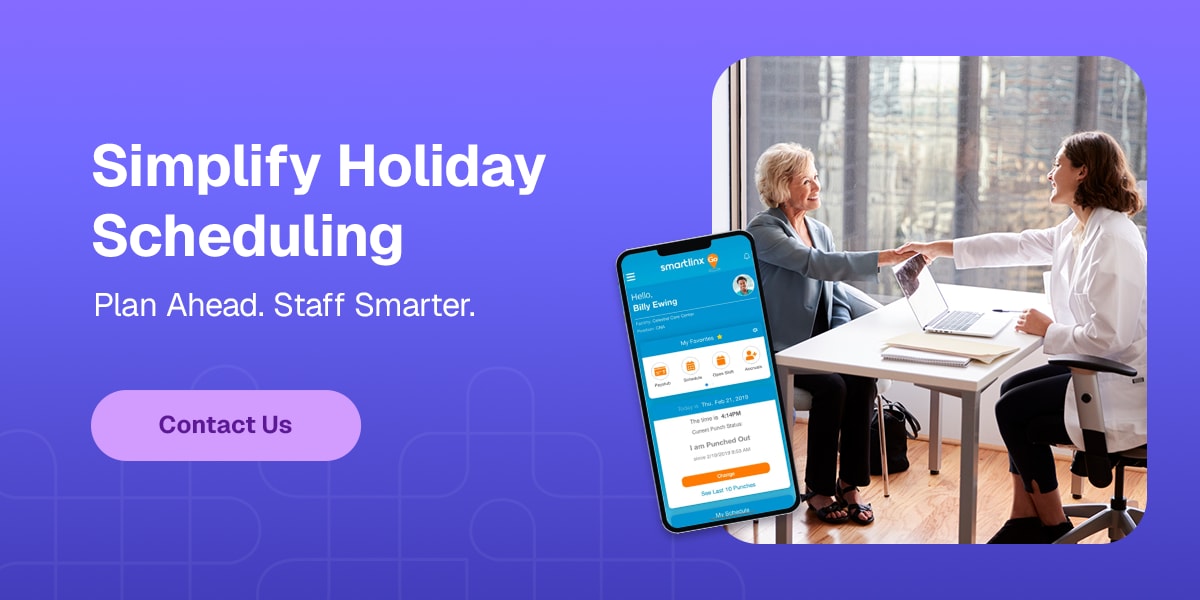
Recalculating holiday pay on a spreadsheet at 11 p.m. in November or scrambling to fill a Christmas morning shift no one saw coming can finally become a thing of the past. Smartlinx Solutions brings team scheduling and payroll together through one cloud-based, unified system built specifically for senior care, so the plan you make in October will still hold strong in December.
Experience less stress this holiday season with a proactive approach. We are always ready to help. Contact us today to learn how a purpose-built platform can support your facility's next holiday staffing plan.