PBJ Mistakes That Trigger CMS Audits
Your skilled nursing facility provides exceptional care every day. Your five-star rating should reflect that dedication without preventable payroll-based journal reporting errors undermining your hard work.
Even minor errors in PBJ submissions can trigger Centers for Medicare & Medicaid Services audits and affect referrals, revenue and public perception on Care Compare. Understanding what triggers an audit and how to respond removes uncertainty. This guide explains typical PBJ mistakes that trigger CMS audits, their real costs and how to build an error-free process.
The Real-World Cost of PBJ Reporting Errors
PBJ reporting mistakes create more than paperwork headaches. They have measurable consequences for your facility's reputation and financial health.
A one-star staffing rating automatically pulls a facility's total score down, regardless of how well you perform in other quality measures. Potential residents and their families searching for care will see the lower rating first. Referral sources notice these ratings and may direct families to higher-rated competitors.
Beyond lost referrals, CMS can impose civil money penalties for noncompliance with PBJ reporting requirements, adding unexpected costs to your operating budget. The administrative burden of responding to an audit — gathering documentation, explaining discrepancies, submitting corrections — pulls your leadership team away from strategic priorities.
Top 5 PBJ Mistakes That Trigger CMS Audits
CMS uses PBJ data to calculate the staffing component of its quality rating system, so accuracy matters. Here are the five most common audit triggers.
1. Inaccurate Meal Break Deductions
Facilities must deduct meal breaks from reported hours, regardless of whether the employee actually took the break. This rule applies to all staff, including salaried and contract workers. Failing to deduct meal breaks results in overstated staffing hours, a glaring red flag for auditors.
If 50 employees work five days a week and each takes a 30-minute meal break, that's 125 hours per week of potential overreporting. Over a quarter, that discrepancy compounds into hundreds of hours that don't reflect actual direct care time.
Auditors who identify this pattern see a systemic compliance issue that erodes the credibility of all your PBJ data. This pattern often triggers deeper scrutiny of other reporting areas.
2. Incorrectly Reporting Overnight Shifts
Facilities should report all hours on the calendar day staff members work them. For example, a shift that runs from 11 p.m. on Monday to 7 a.m. on Tuesday requires a split. You should report one hour on Monday and seven hours on Tuesday.
Most traditional payroll systems can't handle this automatically. They track shifts as single units tied to when the shift starts, not when each hour occurs. This disconnect produces unintentional inaccuracies that create dramatic swings in daily staffing levels — which runs counter to the stable, reliable care CMS expects.
Submitted hours that show significant gaps compared to verified hours may result in an automatic one-star staffing rating. The PBJ Policy Manual provides detailed guidance on calendar day reporting.
3. Missing or Inaccurate Contractor and Agency Staff Hours
Facilities must report direct care hours for all staff, including agency and contract workers. This blind spot is typical for administrators who track contractor data separately from employee payroll. Omitting these hours significantly underreports true staffing levels.
Auditors compare PBJ data to invoices and contracts for these services. Misaligned numbers raise questions about data aggregation processes and your reporting accuracy. Perfect employee hour tracking won't protect you if contractor data is missing — the gap still triggers flags and penalties.
Managing a blended workforce is a challenge for skilled nursing facilities, and accurate reporting requires a system that centralizes all staffing data.
4. Misclassifying Staff Roles
In addition to reporting hours, you must accurately record the care your staff provides. Base reporting on the primary role a person performs during their shift, and accurately map internal job titles to CMS job codes.
Misclassifying staff can skew the reported skill mix of your facility. Incorrectly coding an RN as an LPN will underrepresent your nursing expertise. Similarly, coding a certified nursing assistant incorrectly will distort your direct care staffing ratios. These inaccuracies affect how CMS evaluates care quality and appropriateness.
Review the CMS Technical User's Guide for the official list to ensure your job codes are accurate.
5. Submitting Late or Incomplete Data
Timeliness is a critical component of PBJ compliance. Even if your data is accurate, submitting it after the deadline can result in penalties for noncompliance.
Late submissions earn an automatic one-star staffing rating for the quarter. Incomplete submissions may also result in penalties. Facilities must remain audit-ready at all times.
How to Build an Error-Free PBJ Process
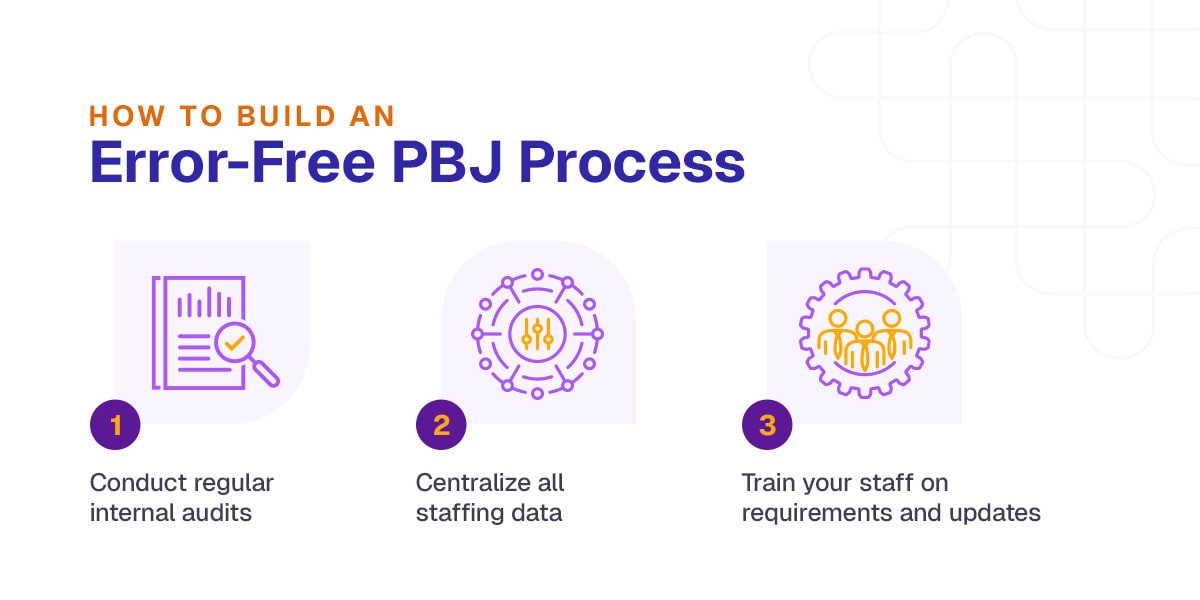
Avoiding PBJ errors requires a proactive, system‑driven approach that focuses on preventing issues rather than scrambling to correct them later.
- Conduct regular internal audits: Review your PBJ data before submission by comparing reports to payroll records, contractor invoices and time and attendance logs. Identify discrepancies and treat these audits as practice runs for CMS reviews — the more you catch internally, the less auditors will find.
- Centralize all staffing data: Separate platforms for employee payroll, time and attendance and agency contractor information create multiple entry points for error. A unified system reduces manual data entry and gives you a single source of truth to work from.
- Train your staff on requirements and updates: Your team must stay abreast of evolving CMS guidance, including rule changes, submission deadlines and technical requirements. Streamlining administration and operations is central to compliance.
Frequently Asked Questions About PBJ Mistakes
Mistakes happen, even with the best processes. Your response can minimize the impact on your facility.
What Should I Do if I Find an Error After Submission?
You can submit corrected files through the PBJ system. Access the portal, upload your revised data and document what changed and why. The sooner you correct a mistake, the better — especially if you discover it before an audit notice arrives.
What Happens During a CMS Audit?
During an audit, you'll receive a request for documentation to verify your submitted PBJ data. You'll need to quickly deliver records such as payroll reports, timecards, contractor invoices and employee schedules. Failure to provide these documents within the specified window may result in audit failure. Being audit-ready requires keeping these records organized and accessible at all times.
Can I Appeal a Penalty?
You can appeal against some penalties. The appeals process begins with informal dispute resolution, where you submit documentation to prove that the deficiency was incorrect. If that doesn't resolve the issue, you can request a formal review within 60 days of the penalty. This process may involve an administrative law judge. Further appeals are possible through the Departmental Appeals Board and federal courts.
Protect Your Five-Star Rating With Smartlinx
You've learned how to sidestep the most technical, stressful PBJ pitfalls. Now, it's time to put those insights into action with a system that protects your facility.
Smartlinx handles the complexity of PBJ reporting for you. Our unified, purpose-built platform pulls all your staffing data into one place, flags potential errors early and ensures every submission meets CMS standards.
Discover how Smartlinx PBJ reporting software and our Five-Star Predictor tool help you proactively manage your CMS rating. Schedule a demo with our team to see how Smartlinx can streamline your PBJ reporting and protect your stellar rating.