Senior Care Scheduling Software vs. Generic Tools
Every day, you face the same challenge — create schedules that meet shifting regulatory demands, accommodate varied staff certifications and prevent the burnout that drives your best nurses out the door. Managing these complexities requires equally sophisticated software to build a robust foundation and reduce risk to your facility.
Comparing the critical features of senior care scheduling software to generic tools will empower you to build a powerful business case for a solution that helps maintain compliance, control labor costs and reduce staff burnout. Purpose-built software can help you protect your facility's reputation and bottom line by addressing the unique operational demands of senior care.
The Basics of Staff Scheduling
At its core, any scheduling software handles fundamental tasks like creating shifts, assigning employees and managing time-off requests. You can use generic tools to build a calendar of who works when and adjust it as needed. Features like shift swapping, availability tracking and simple reporting come standard with these platforms.
While these baseline capabilities work well for industries with straightforward staffing needs, they fall short when your facility is subject to strict regulatory oversight. Generic scheduling tools are typically designed to support a wide range of industries, whether you're staffing a retail store or a senior living or skilled nursing facility. The real challenge is whether that schedule automatically monitors compliance, tracks specialized credentials and adapts to the constant census and acuity fluctuations that define senior care operations. Without industry-specific intelligence built in, you'll have to layer manual processes on top of basic tools, creating inefficiency and risk.
The Hidden Risks of Using Generic Software in Senior Living
Using the wrong scheduling tool exposes your facility to costly risks that affect your bottom line and regulatory standing. One facility reduced overtime costs by 25% after switching from generic tools to purpose-built senior care scheduling software. It optimized shift assignments and flagged scheduling inefficiencies before they became costly problems. Consider these risks as you evaluate whether generic software is adequate for your needs.
- Financial exposure from excessive overtime: Manual scheduling and poor shift coverage result in costly overtime, which represents one of the most significant controllable expenses in senior care operations.
- State and federal survey deficiencies: Failing to meet baseline federal staffing laws or strict state-specific staffing ratios can negatively impact survey outcomes and quality ratings.
- Inability to respond to census changes: Census fluctuations leave you either overstaffed and wasting money or understaffed and potentially falling below staffing requirements, if you can't quickly adjust staffing levels to meet resident needs.
- Manual compliance tracking burden: Hours spent building compliance spreadsheets and manually calculating ratios steal time from strategic leadership responsibilities aimed at improving your facility's operations and culture.
- Staff dissatisfaction and turnover costs: Recruiting, hiring and training replacement staff consumes significant resources you could otherwise invest in improving care quality, while constant turnover disrupts team cohesion and resident relationships.
The Unique Complexities of Senior Care Scheduling
You'll immediately notice operational dilemmas when comparing senior care scheduling software to generic tools. Standard solutions can't address your facility's unique demands. The stakes are higher, the regulations are stricter and the consequences of scheduling errors extend far beyond inconvenience. Appreciating these unique challenges will help you see the value of a purpose-built platform.
Navigating Evolving State and Federal Staffing Requirements
Nursing homes are highly regulated by the government. You must provide sufficient staff for your residents. Federal nursing staffing requirements continue to evolve, and many states impose additional staffing mandates and ratio requirements. Plus, many states now have their own strict staffing laws with heavy fines.
Since generic scheduling tools can't automatically calculate against these changing staffing rules, manual verification becomes your only option. You'll need to check whether each shift meets the requirements, build compliance tracking spreadsheets and hope you catch errors before they become violations. Census changes or unexpected call-ins throughout the day create blind spots where generic software offers no insight into your compliance status.
Purpose-built senior care scheduling software tracks these metrics in real time, automatically flagging schedules that fall below required thresholds. It integrates with your census data to help align staffing levels with resident needs and staffing requirements. It also streamlines PBJ reporting by capturing the data you need in the format CMS requires, giving you continuous visibility into your compliance status.
The Challenge of High Staff Turnover and Burnout
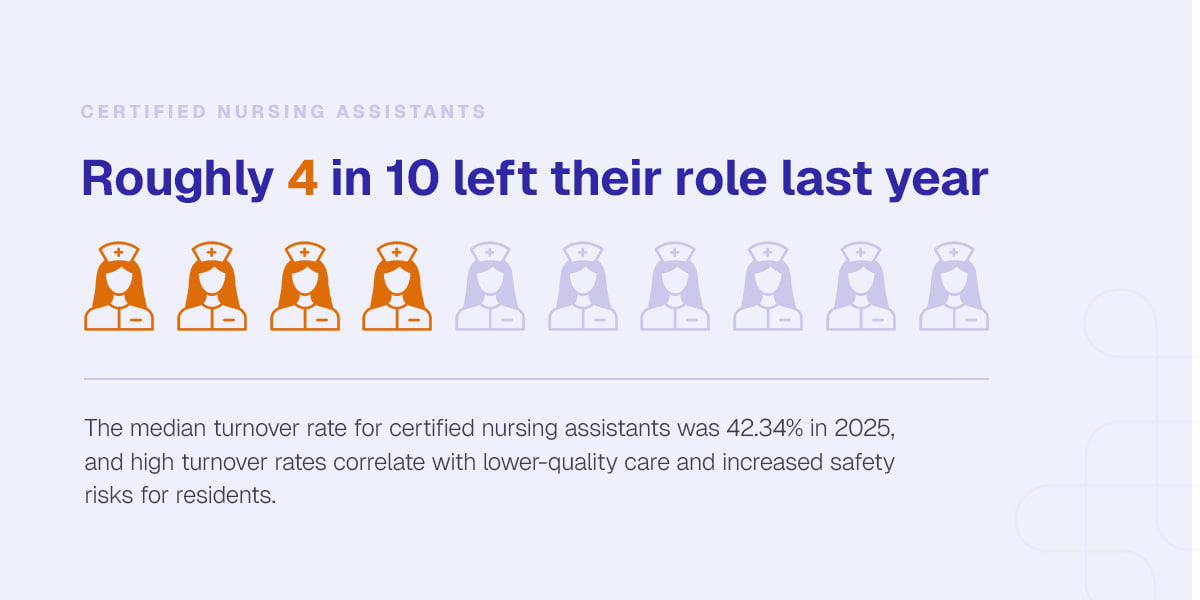
The senior care industry faces persistent staffing challenges. The median turnover rate for certified nursing assistants was 42.34% in 2025, and high turnover rates correlate with lower-quality care and increased safety risks for residents. Poor scheduling practices accelerate this burnout cycle.
- Last-minute schedule changes: Constant alterations to published schedules disrupt personal plans and create unpredictability, eroding trust among team members.
- Difficult time-off request processes: Staff who must call or email with every request and wait days for approval feel undervalued and unheard, especially when competing employers offer instant mobile request systems.
- Lack of shift-swapping flexibility: Basic tools do not let staff request shift swaps or view open shifts on the go, making it hard to fix schedule conflicts quickly from their phones.
- Forced overtime from inadequate coverage: Mandatory extra shifts lead to exhaustion and resentment, especially when preventable scheduling gaps cause the overtime.
- No visibility into available hours: Staff who want more hours can't see opportunities, while those seeking work-life balance can't plan effectively, creating frustration on both sides of the scheduling equation.
Purpose-built solutions give staff mobile access to schedules, self-service shift swapping and transparency into available hours. Greater schedule flexibility and transparency can help improve employee satisfaction and support retention efforts, reducing your recruitment costs and maintaining continuity of care.
Managing Diverse Staff Certifications and Skills
Your workforce includes RNs, licensed practical nurses, CNAs and specialized staff with varying credentials and certifications. Each of these positions has specific scope-of-practice limitations, and those certifications expire on different schedules. You can't assign an LPN to a shift that requires RN-level clinical judgment, and you can't schedule someone whose certification has lapsed without exposing your facility to serious liability.
Generic scheduling tools don't understand these nuances. Accidental assignment of unqualified staff poses a real risk, creating both compliance concerns and patient safety issues. That means you need to manually track assignments and verify credentials yourself, which creates bottlenecks if you need to fill shifts quickly.
Purpose-built software for senior care maintains staff credentials, alerts schedulers when employees do not meet required qualifications and as certifications approach expiration. Need to fill an open RN shift? The system shows only qualified available RNs, helping eliminate noncompliance risk.
Essential Features of a True Senior Care Scheduling Solution
As you weigh senior care scheduling software against generic tools, look for features that help you optimize your workforce, control costs and maintain compliance. A comprehensive solution should include these capabilities:
- Automated compliance tracking: Real-time monitoring of HPRD, staffing ratios and CMS requirements with alerts for schedules that fall below your staffing rules.
- Credential management: Built-in tracking of licenses, certifications and skills with alerts for unqualified assignments.
- Census integration: Dynamic adjustment of staffing requirements based on current resident count and acuity levels.
- Mobile access for staff: Self-service scheduling, shift swapping and time-off requests through an intuitive mobile app.
- Intelligent shift filling: Automated identification of qualified available staff to quickly fill open shifts.
- Integration with payroll and HR systems: A single, unified platform that eliminates duplicate data entry and ensures payroll compliance by accurately capturing hours worked.
- Robust reporting and analytics: Detailed insights into labor costs, overtime trends, schedule efficiency and compliance metrics.
End Your Scheduling Chaos With Smartlinx
Staffing ratios, credential management and high turnover create demands that generic scheduling tools can't handle. We built Smartlinx from the ground up to solve the unique challenges you face every day. Our unified, cloud-based platform automatically tracks compliance with CMS staffing mandates, manages certifications and credentials and gives your staff the mobile flexibility they need to reduce burnout.
Thousands of senior care organizations trust Smartlinx to optimize their workforce management while controlling labor costs. We understand the weight you carry as an administrator, and we're here to lighten the load. Request a demo today to discover how we can transform your scheduling into a strategic advantage.